How much does an e-commerce website cost in India?
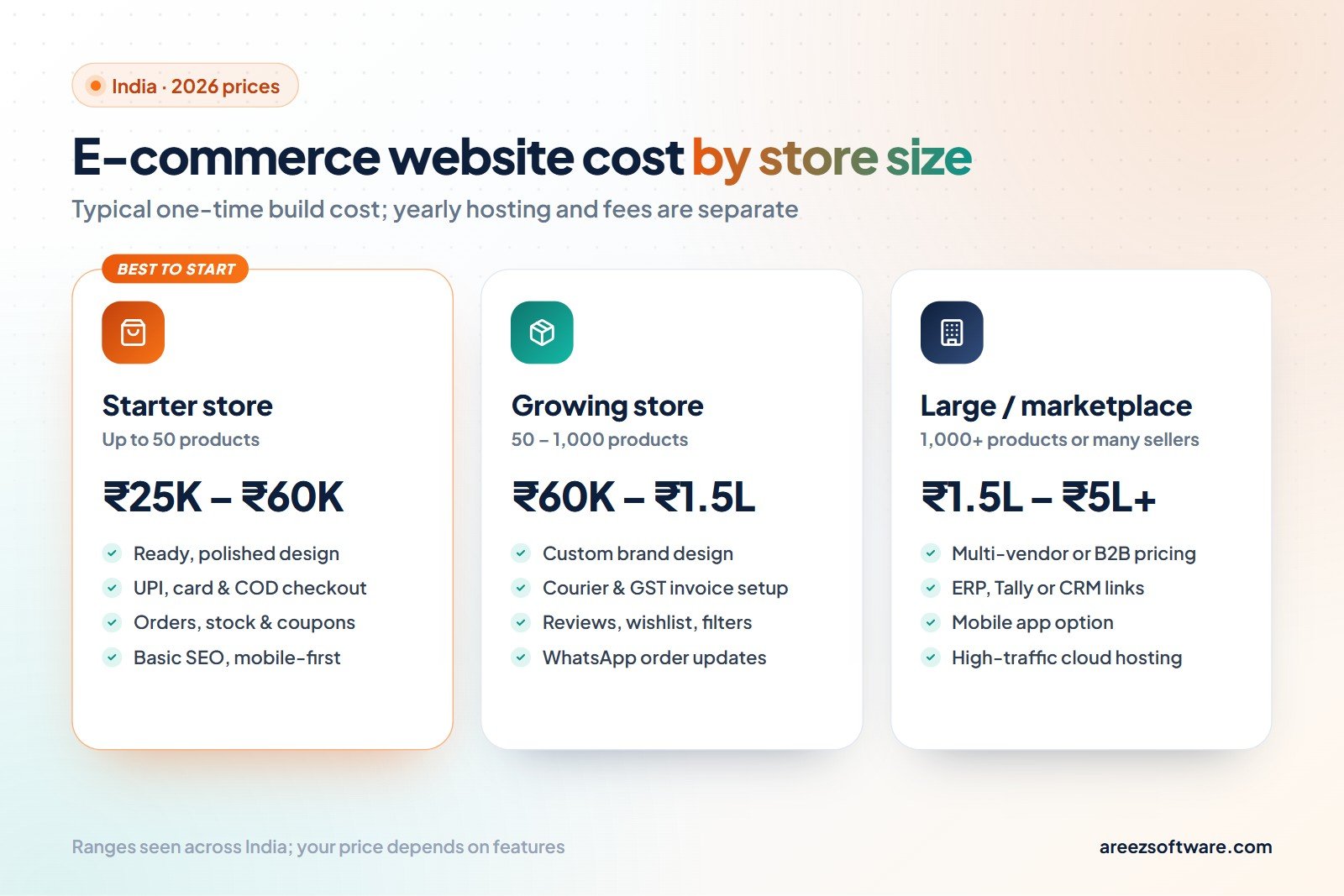
In short: the e-commerce website development cost in India in 2026 starts from about ₹25K for a small online store and goes up to ₹1.5 lakh for a growing store with hundreds of products. Large stores and multi-vendor marketplaces cost ₹1.5 lakh to ₹5 lakh or more. The biggest factors are how many products you sell and which features you need.
E-commerce website price list in India (2026)
| Store type | Size | Typical cost | Good for |
|---|---|---|---|
| Starter store | Up to 50 products | ₹25K – ₹60K | Boutiques, home bakers, local shops and new D2C brands. |
| Growing store | 50 – 1,000 products | ₹60K – ₹1.5 lakh | Brands with many variants, regular offers and daily orders. |
| Large store | 1,000+ products | ₹1.5 lakh – ₹3 lakh | Retailers with big catalogues, stock in many places and ERP links. |
| Multi-vendor marketplace | Many sellers | ₹3 lakh – ₹5 lakh+ | Platforms where other sellers list products and get paid. |
Need a normal business website, not a store? See our full website development cost in India guide for static and dynamic website prices.
What a ₹25K online store includes
A proper starter store is much more than a page with products. Our e-commerce package, starting from ₹25K, comes ready to take real orders:
- Product catalogue, cart & checkout
- Payment gateway (UPI, cards, net banking)
- Order & inventory management
- Shipping, delivery & invoice setup
- Customer accounts & order history
- Coupons & discount codes
- Mobile-friendly design, SSL and basic SEO
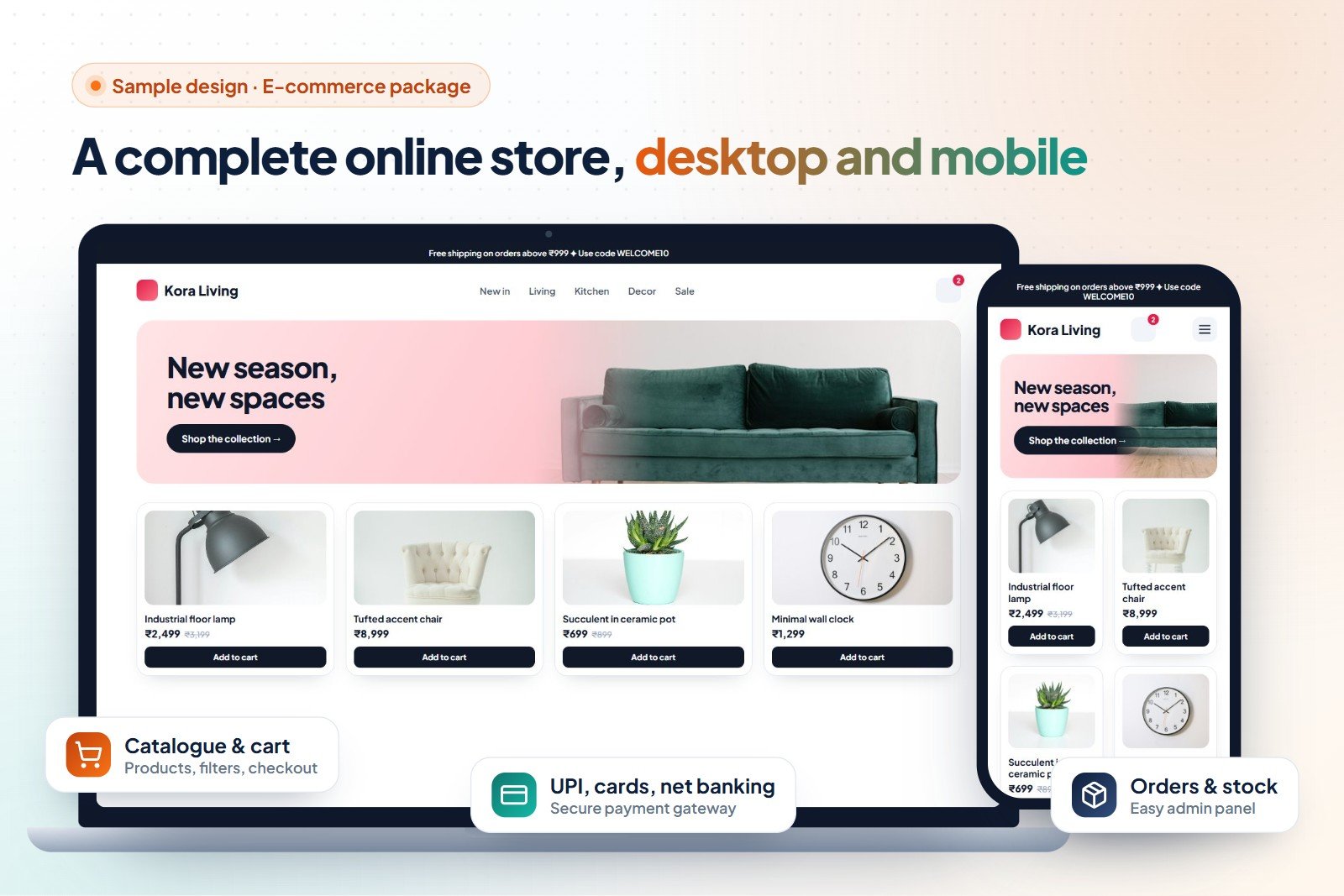
Price depends on catalogue size, payment and shipping setup. You can see the full design on desktop and mobile in our pricing section, or read more about our e-commerce development service.
Where your e-commerce budget actually goes
When you get a quote for an online store, the money is split across six main jobs. Here is a typical split for a ₹60K store with around 200 products:
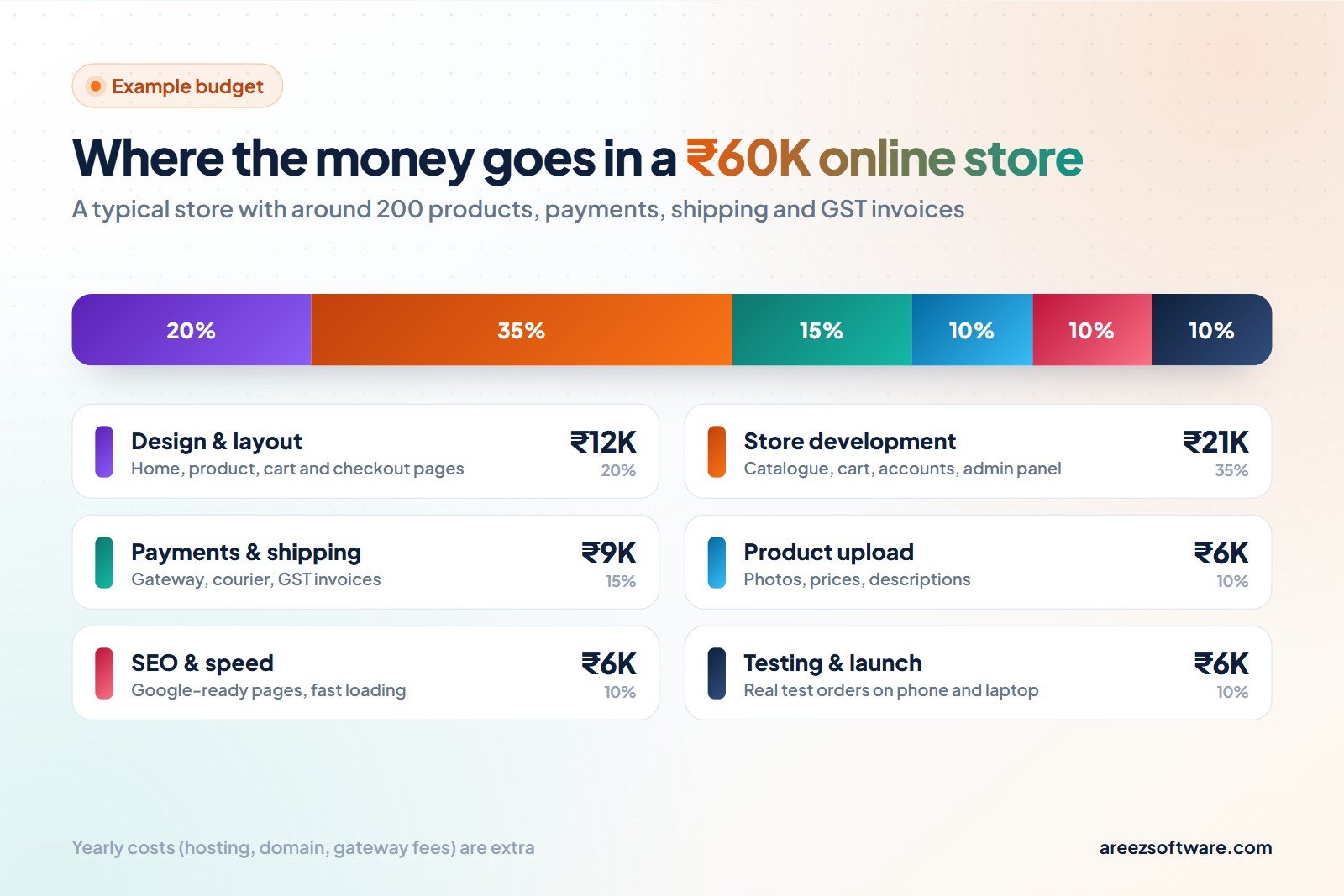
- Design & layout (about 20%). Home, category, product, cart and checkout pages, designed for phones first.
- Store development (about 35%). The catalogue, cart, customer accounts and the admin panel where you manage everything.
- Payments & shipping (about 15%). Connecting the payment gateway, courier partner, delivery charges and GST invoices.
- Product upload (about 10%). Adding photos, prices, sizes and descriptions. Free if you upload products yourself.
- SEO & speed (about 10%). Clean product URLs, Google-ready titles and fast loading on mobile data.
- Testing & launch (about 10%). Placing real test orders, refunds and cancellations before the store goes live.
Easy saving: product upload and content are the easiest parts to do yourself. If you add your own products from the admin panel, your quote can drop by around 10%.
Shopify vs WooCommerce vs custom: e-commerce cost compared
The platform you build on changes both the first cost and what you pay every month. None of them is “best” for everyone:
Shopify
Ongoing: Monthly plan + paid appsGood: Fast to launch, easy to use, no server to manage.
Watch out: Monthly fees in dollars or rupees forever; apps add up; extra fee per sale with some payment gateways.
WooCommerce (WordPress)
Ongoing: Hosting + some paid pluginsGood: The plugin is free and you own everything. Huge choice of themes and plugins.
Watch out: Needs regular updates and good hosting, or it becomes slow and unsafe.
Custom-built store
Ongoing: Hosting + maintenanceGood: Built exactly around your business: special pricing, B2B, marketplaces, ERP links.
Watch out: Higher first cost and a longer build. Only worth it when ready platforms cannot do the job.
Simple rule: if you sell normal products to normal customers, a ready platform is enough. Choose a custom store only when you need something special, such as different prices for wholesale buyers, a marketplace with many sellers or a link to your billing software.
Features that change the e-commerce website price
Every order passes through the same five steps. Your store must handle each one smoothly, especially on a phone:
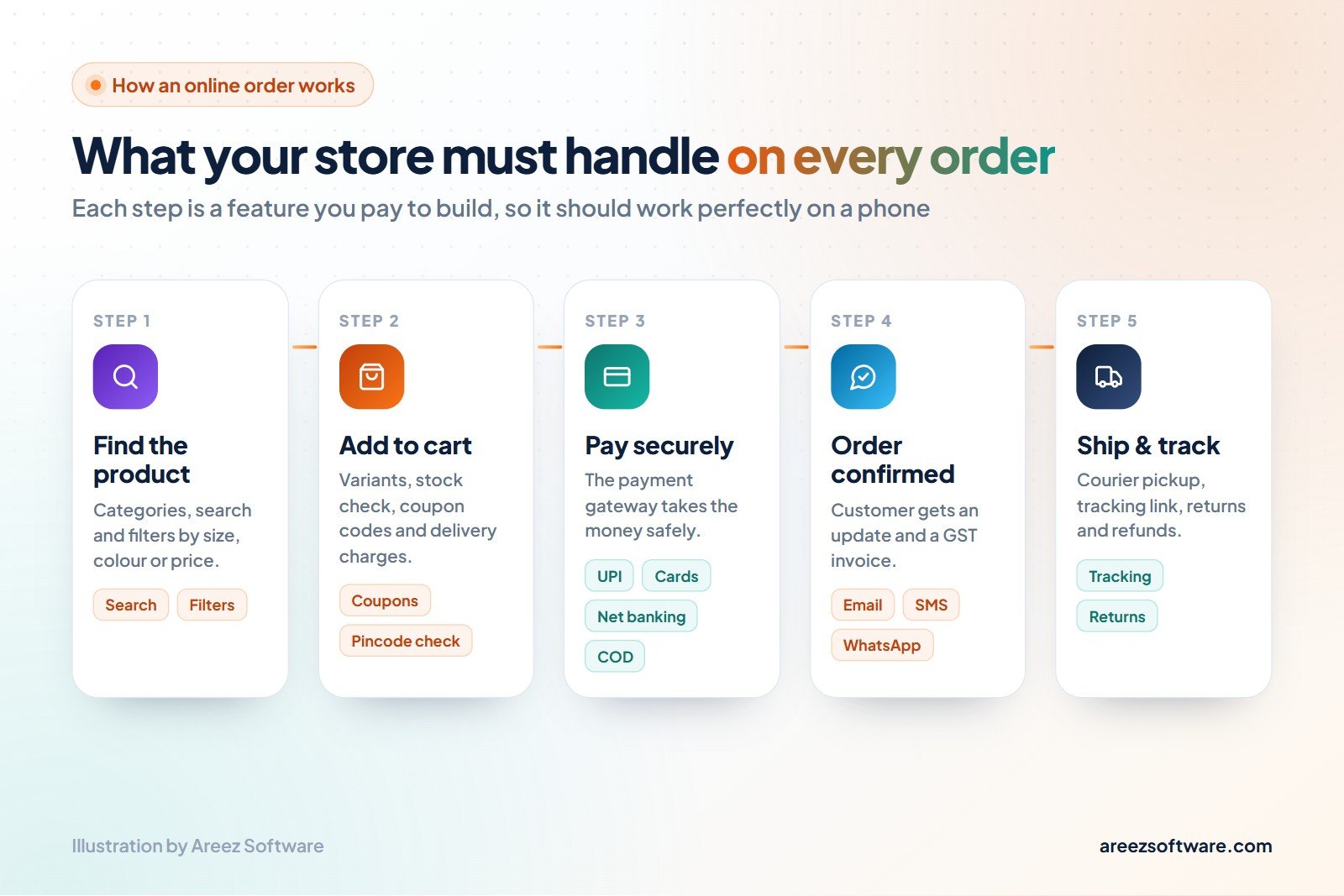
These popular extras are where quotes start to differ. Typical add-on costs in India:
WhatsApp order updates
₹3K – ₹10KOrder and delivery messages on WhatsApp. Message charges from the provider are extra.
Courier & tracking setup
₹5K – ₹15KAuto-book pickups with a shipping partner and send tracking links to customers.
Pincode & COD rules
₹3K – ₹8KCheck delivery by pincode and turn COD on or off by area or order value.
Product upload by us
₹20 – ₹60 per productDepends on how many photos, sizes and colours each product has.
Multi-language store
₹10K – ₹30KHindi or regional language versions of your store and product pages.
Tally / ERP / CRM link
₹15K – ₹60KSync stock, orders and invoices with the software you already use.
Multi-vendor marketplace
₹1.5 lakh+Seller sign-up, seller dashboards, commissions and payouts.
Android & iPhone app
₹1 lakh+A shopping app on top of your store. Best added once the website sells well.
Monthly and yearly cost of running an online store
Building the store is a one-time cost. These are the costs that continue while it is live:
| Item | Typical cost | What it is |
|---|---|---|
| Domain name (.in / .com) | ₹700 – ₹1.5K / year | Your store address. Keep it registered in your own name. |
| Hosting | ₹3K – ₹25K / year | More products and visitors need faster hosting. Shopify includes hosting in its plan. |
| SSL certificate (https) | Usually free | Needed for safe payments; included with most good hosting. |
| Payment gateway fees | ~2% per sale + GST | Charged on each successful payment. GST is added on the fee, not on your sale. |
| Shipping | Per order | Depends on weight and distance. COD orders and returns cost extra. |
| Paid apps / plugins | ₹0 – ₹3K / month | Reviews, WhatsApp, filters or invoices, if not built into your store. |
| Maintenance & updates | ₹2K – ₹10K / month | Optional. Security updates, backups, new banners and small changes. |
Example: a store doing ₹1 lakh of sales a month pays roughly ₹2K in gateway fees (plus GST on the fee), on top of hosting and shipping. Add maintenance if you want someone to handle updates, backups and new banners for you.
How to start an online store on a small budget
Most successful Indian online stores did not start big. Here is how to launch for less:
- Start with your best 20–50 products. You do not need your full catalogue on day one. Add more products once orders start coming.
- Use a ready, polished design. A good ready layout with your logo and colours costs far less than a fully custom design.
- Upload products yourself. Take clear photos on your phone in daylight and add them from the admin panel. It saves thousands.
- Turn on UPI and COD first. Most Indian buyers pay by UPI or cash on delivery. Add EMI and wallets later if customers ask.
- Add apps and extras later. WhatsApp alerts, loyalty points and a mobile app can all come after the store makes money.
Tip: keep selling on Instagram, WhatsApp or marketplaces too. Use your own store to collect repeat customers, so you pay no marketplace commission on them.
Checklist before you hire an e-commerce developer
- A written, itemised quote listing pages, features and what is NOT included
- Domain, hosting and payment gateway accounts registered in your own name
- Admin access and training so you can add products and manage orders yourself
- Test orders on a real phone: UPI, card, COD, cancel and refund
- Mobile speed checked, because most Indian shoppers buy on their phones
- Basic SEO included: product titles, descriptions, sitemap and Google Search Console
- GST invoice, return policy, privacy and terms pages before launch
- A clear support plan for the first months after launch
Red flags in an e-commerce quote
A full store for ₹5K
Prices far below the market usually mean a copied theme, no payment testing and no support after launch.
Accounts in their name
If the developer owns your domain or payment gateway account, you can lose your store and money flow.
No test orders shown
Always see a real order go from cart to payment to invoice before you pay the final amount.
“Unlimited products included”
Building the store and uploading products are separate jobs. Ask who uploads them and at what price.
Frequently asked questions about e-commerce website cost
What is the e-commerce website development cost in India in 2026?
A small online store in India typically costs ₹25K to ₹60K, a growing store with 50 to 1,000 products ₹60K to ₹1.5 lakh, and a large store or multi-vendor marketplace ₹1.5 lakh to ₹5 lakh or more. At Areez Software, e-commerce stores start from ₹25K.
What is the cheapest way to start an online store in India?
Start with a ready, polished design, 20 to 50 of your best products, UPI and cash on delivery, and upload the products yourself. You can add more products, apps and features once the store starts selling.
Is Shopify cheaper than a custom e-commerce website in India?
Shopify is usually cheaper to start, but you pay a monthly plan and paid apps for as long as the store runs, and some payment gateways add an extra Shopify fee per sale. WooCommerce and custom stores cost more upfront but have lower monthly fees and you own the code.
What are payment gateway charges in India?
Most Indian payment gateways charge around 2% per successful transaction on standard plans, with 18% GST added on that fee. International cards and some card types can cost more. There is usually no setup fee for standard plans.
How much does it cost to run an e-commerce website every year?
Plan for a domain (about ₹700 to ₹1.5K a year), hosting (about ₹3K to ₹25K a year), around 2% payment gateway fees on each sale, shipping costs per order and optional maintenance of ₹2K to ₹10K a month.
How long does it take to build an e-commerce website?
A starter store usually takes 3 to 5 weeks once your products, photos and policies are ready. Larger stores take 6 to 12 weeks, and marketplaces or stores with ERP links are planned and delivered in stages.
Do I need GST registration to sell online in India?
Rules depend on what you sell, your turnover and whether you sell through marketplaces like Amazon or Flipkart. Ask your CA before launch. If you are GST-registered, your store can create GST invoices for every order automatically.
Should I build an e-commerce app or a website first?
Start with a mobile-friendly website. It works on every phone without a download and is found on Google. Add an Android and iPhone app later, once you have regular repeat customers.
What is included in your e-commerce package?
Our e-commerce package (from ₹25K) includes product catalogue, cart & checkout, payment gateway (upi, cards, net banking), order & inventory management, shipping, delivery & invoice setup, customer accounts & order history, coupons & discount codes. Price depends on catalogue size, payment and shipping setup.
Prices are typical ranges seen across India as of October 31, 2026 and vary by city, scope and provider. Payment gateway, platform and shipping fees are set by those providers and can change; check their current pricing. Our package price is a starting price; your final quote depends on your products and features.